
Insights
DAIM Insight
Explore the latest trends in manufacturing and logistics innovation through expert insights.
Opening
Physical AI: From Technology to Industry
Semiconductors and AI data centers have established products, business models, and industrial ecosystems. Physical AI, by contrast, is still taking shape as an industry.
What will it take to turn South Korea’s manufacturing infrastructure into a competitive advantage in Physical AI?
We examine the priorities for securing industrial leadership, focusing on data standardization, equipment interoperability, and international joint validation.
Key Highlights
Three Key Priorities for Industrializing Physical AI
-
Key Highlight 01
Building safe, reliable industrial systems by integrating AI, sensors, actuators, and communication networks
-
Key Highlight 02
Standardizing data, interfaces, and communication protocols for interoperability across heterogeneous equipment and systems
-
Key Highlight 03
Establishing standards and an ecosystem for validation and commercialization through international collaboration and joint validation
Trend
DAIM Thoughts
Physical AI Competitiveness: Why Standards Matter

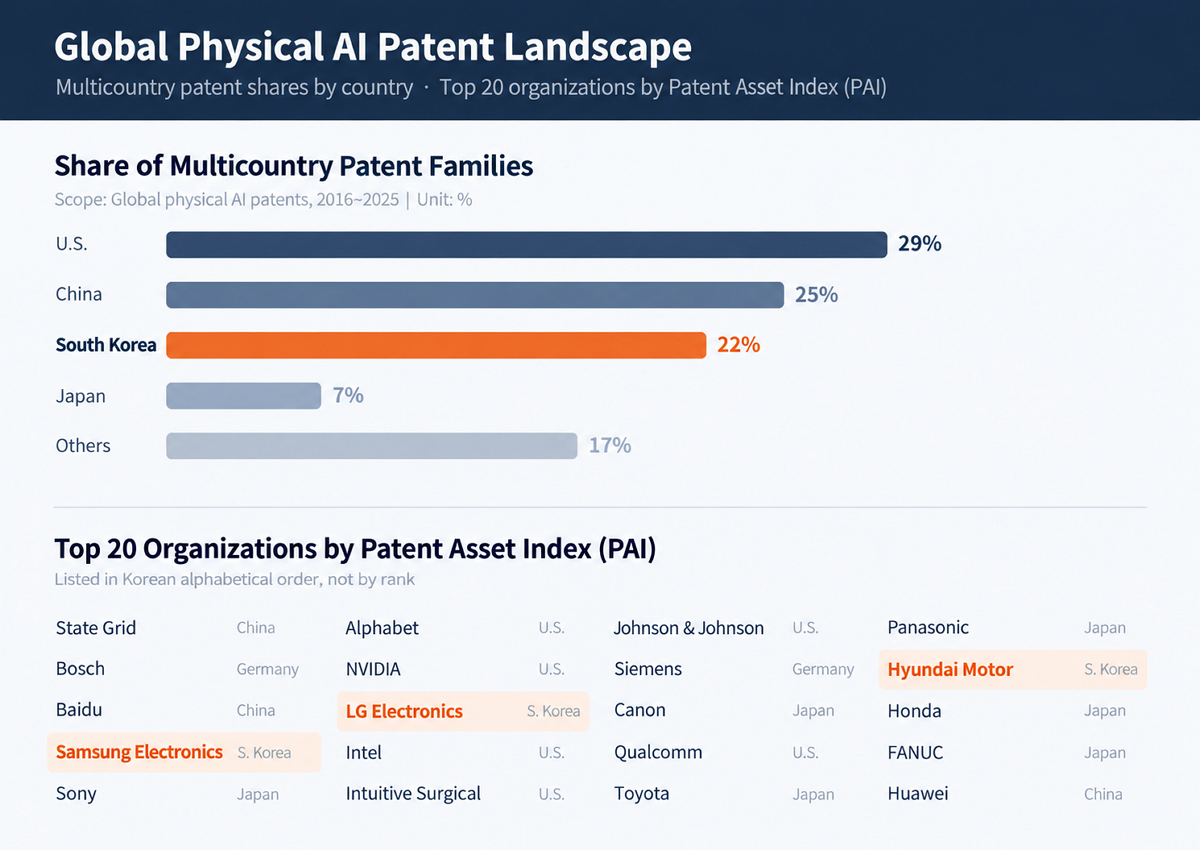
[Source: Maeil Business Newspaper–LexisNexis global Physical AI patent analysis, reported September 21, 2026. Infographic created with AI assistance.]
https://www.mk.co.kr/news/it/12157568
Physical AI perceives the real world, makes decisions, and takes physical action. Its success depends on more than a powerful AI model.
If the AI model is the brain, sensors are the eyes and ears, actuators the limbs and muscles, and communication networks the blood vessels connecting them. Physical AI is a competition in both AI intelligence and industrial systems that operate safely and reliably in the real world.
A recent global Physical AI patent analysis ranked South Korea third in patent filings across multiple countries, behind the United States and China. Despite a slower start in generative AI, South Korea is seen as having an opportunity to regain ground through manufacturing infrastructure spanning integrated physical platforms and AI semiconductors. This foundation gives the country the potential to lead global standards in Physical AI.
Building an Industry Beyond the Technology
South Korea is advancing three national megaprojects: semiconductors, AI data centers, and Physical AI. Semiconductors and AI data centers have established products, business models, and industrial ecosystems. Physical AI, however, remains closer to a technology than a fully formed industry. Defining the products and industries it will support remains an open challenge.
Physical AI has yet to establish a global industry structure, common standards, or a dominant business model. Developing it requires pioneering not only products and services, but also markets, supply chains, standards, and institutions.
Common Standards Connecting Data and Equipment
Data standardization and equipment interoperability are central to this effort.
Equipment and systems from different companies need shared data models, interfaces, and communication protocols to interpret data and communicate safely.
These standards define the rules for entering future markets and provide a common industrial language through which data flows and equipment connects. Leadership in global supply chains may depend on who establishes these standards first and shapes international norms.
Standards development must therefore advance alongside technology development. South Korea must build on its manufacturing infrastructure and technical capabilities to create opportunities to lead global standards.
Open Architectures and International Joint Validation

[Image credit: AI-generated]
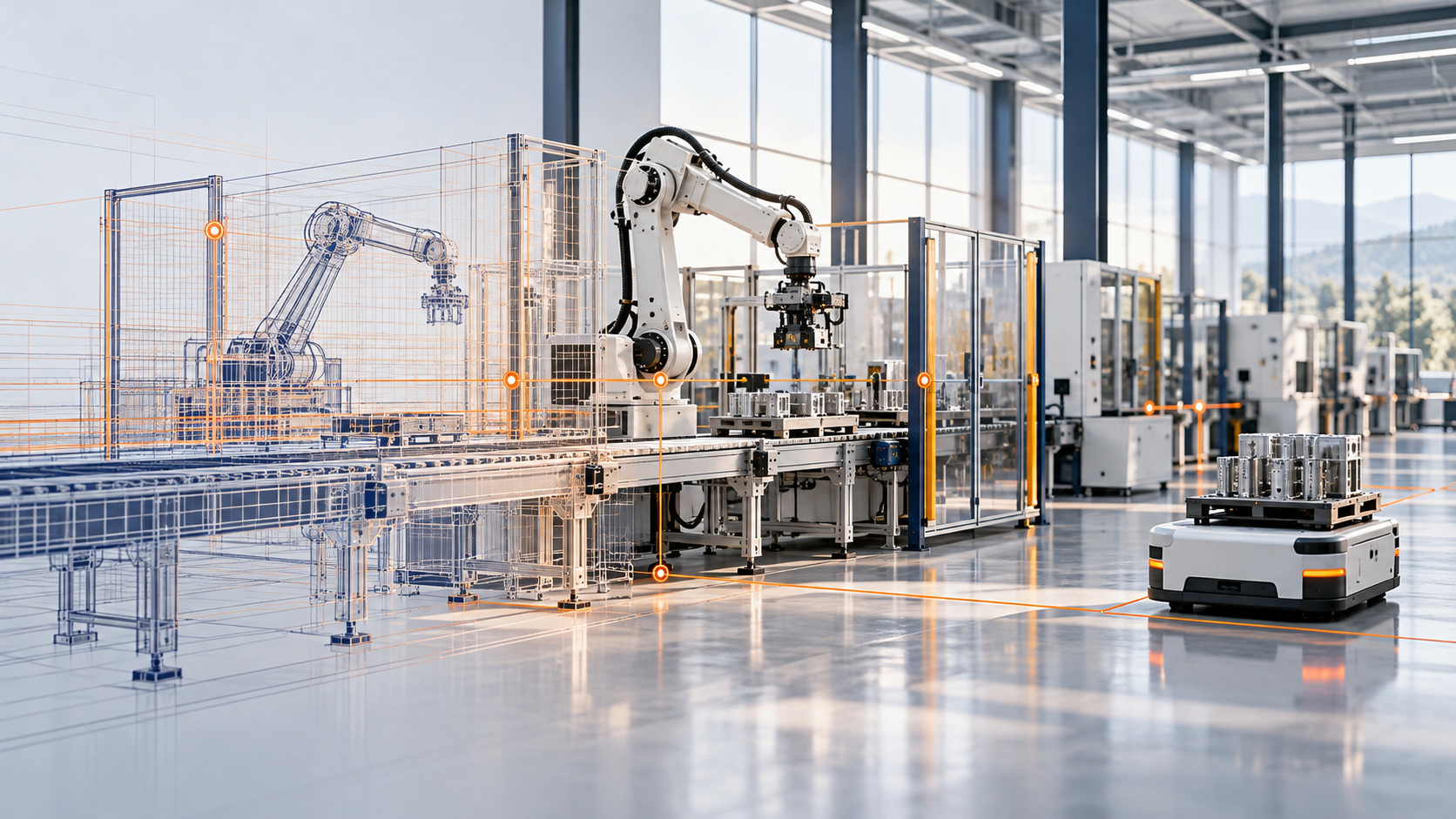
Physical AI must be designed from the outset with an open architecture that addresses international interoperability, safety, security, and data sovereignty. Common standards for connecting equipment and systems must also account for the safety and security of those connections.
Joint validation with overseas research institutions, standards bodies, customer companies, and platform providers is equally important.
These partnerships should establish shared standards and create pathways into international markets. International collaboration and joint validation connect domestic technologies and industries with global standards and supply chains.
Beyond R&D: Validation and Commercialization
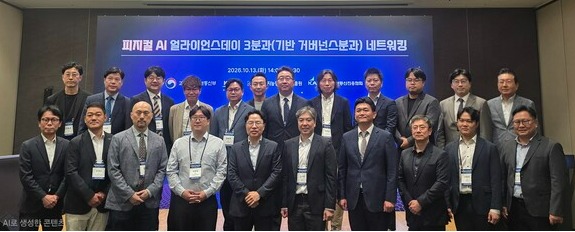
This is why the Physical AI Alliance was launched under the leadership of South Korea’s Ministry of Science and ICT. Its foundational governance division is working with hundreds of companies and institutions to build an ecosystem that extends beyond R&D to standards, global collaboration, validation, and commercialization.
A key task for the division is to connect domestic collaboration with international standardization and global validation initiatives. The goal is an ecosystem in which technology development, standards, international partnerships, validation, and commercialization reinforce one another.
By connecting AI’s brain with industry’s body—and South Korea’s technologies and industries with global standards and supply chains—the Physical AI Alliance will lay the groundwork for making South Korea an indispensable industrial partner.
※ This insight is adapted from DAIM CEO Young Jae Jang’s opinion article, “Physical AI Standardization and an Indispensable South Korea,” published in Hankook Ilbo on September 28, 2026.
[Original Article — September 28, 2026]
Physical AI Standardization and an Indispensable South Korea | Hankook Ilbo
https://www.hankookilbo.com/news/article/A2026092309590002067
2026.10.10DAIM Focus


 썸네일 업무협약_08161.jpg)
 JB미래포럼조찬세미나_436eb.jpg)
 DAIM logo_2ab24.png)
