
1,000 Robots, One Intelligent Platform.
Where thousands of heterogeneous robots operate as one, without congestion or collisions.
xMS powers highly efficient autonomous manufacturing and intralogistics operations.
Why DAIM’s xMS?

As robot fleets grow, congestion and deadlocks become an ongoing challenge that reduces productivity.
xMS optimizes these complex robot movements through AI-powered swarm control, creating uninterrupted material flow. It unifies large-scale, multi-vendor robot fleets under a single control system and continuously recalculates optimal routes in real time as conditions change. Without additional hardware or production line changes, software alone improves productivity. That's the difference xMS makes.
Key Capabilities
How DAIM Simplifies Industrial Complexity
-
Key Capabilities
- Unified Multi-Vendor Robot Control
- A unified control platform orchestrates multi-vendor material handling robots through a standard control protocol. Existing and new robots can be integrated without vendor restrictions, enabling scalable fleet expansion as operations grow.
-
- Physical AI Algorithms
- RL-powered Physical AI algorithms improve robot productivity by over 20%. Without manually defined rules, robots make decisions and move autonomously, enabling fully autonomous operations.
-
- Flexible, Customer-Centric Architecture
- A modular architecture that adapts to each customer's operational requirements. Material handling robots and equipment such as ports, EVs, lifts, and doors can be easily integrated into a unified system.
Proven Impact
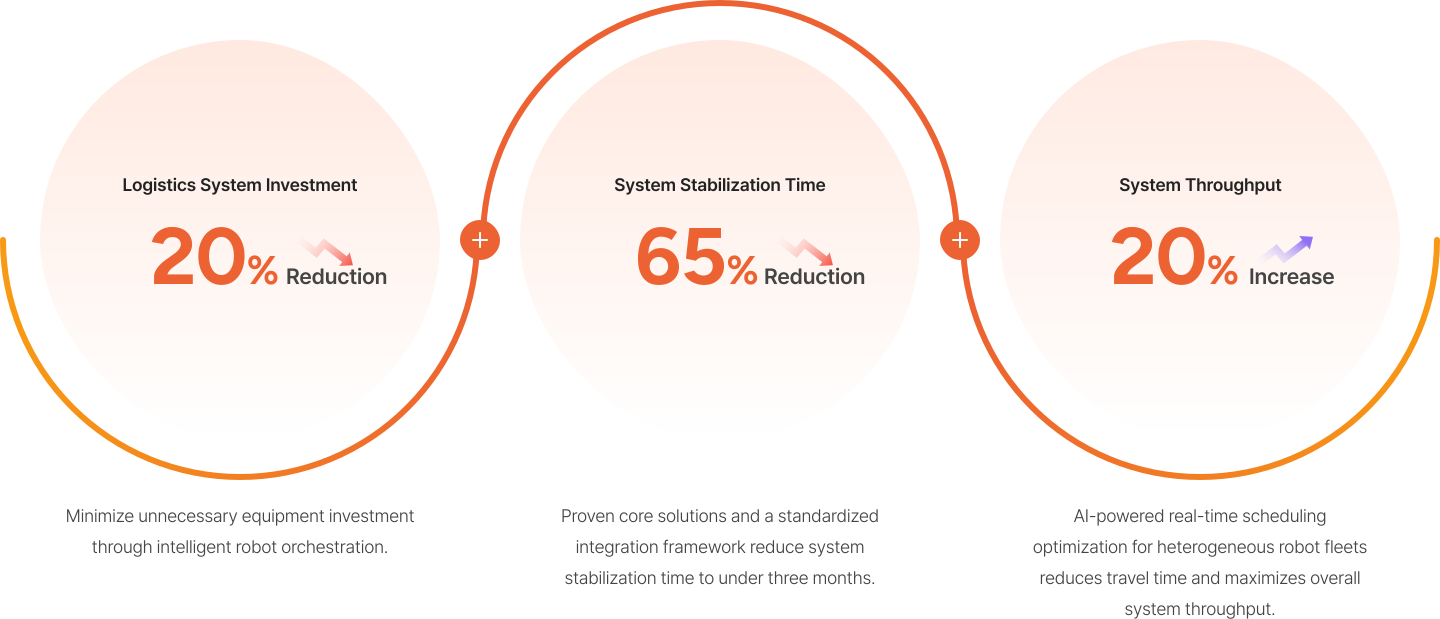
Business Value, Proven by the Numbers
Case Studies
Proven Results from Global Manufacturing Leaders


Semiconductor Manufacturing
-
 Challenge
The biggest challenge in operating more than 1,000 OHTs was managing unexpected congestion. Dozens of engineers monitored the factory 24/7, manually rerouting traffic whenever congestion occurred—but with limited results.
-
 Solution
By deploying the RL-powered logistics optimization solution xMS, bottlenecks were predicted, traffic was redistributed through dynamic route optimization, and transport tasks were reassigned.
-
 Results
Beyond simply avoiding congestion, xMS predicts and prevents congestion before it occurs, demonstrating a higher level of fleet orchestration.
Battery Manufacturing – A
-
Challenge
In addition to maximizing day-to-day efficiency, the system needed to respond reliably to emergencies—such as fire incidents—and urgent orders without disrupting operations.
-
Solution
Applied a real-time dynamic control algorithm that proactively reroutes surrounding robots for urgent orders using priority-based intersection control.
-
Results
Demonstrated that AI can autonomously determine the optimal response to unexpected events while maintaining overall system stability and productivity.
Battery Manufacturing – B
-
Challenge
Integrating more than 250 multi-vendor AMRs into a single coordinated system while achieving target KPIs was a significant orchestration challenge.
-
Solution
Integrated multi-vendor AMRs through a standardized interface, applied predictive deadlock and congestion avoidance algorithms, and validated the system through Digital Twin-based Virtual Commissioning.
-
Results
Demonstrated the ability to orchestrate hundreds of multi-vendor robots as a single coordinated fleet, demonstrating stable operation in complex, large-scale automated environments.
How it Works
How AI Autonomous Operations Improve Operational Efficiency
Collaborative AI Algorithms
Combines reinforcement learning with optimization techniques to optimize robot operations in real time, improving logistics efficiency, reducing investment costs, and enabling stable operation of large-scale robot fleets.
-
- RL-Powered Real-Time Traffic Control
- Continuously analyzes live traffic conditions to generate optimal routes that avoid robot conflicts and minimize congestion.
-
- Real-Time Task and Robot Assignment Optimization
- Uses mathematical optimization to dynamically assign and reassign tasks to robots, maximizing operational efficiency.
-
- Deadlock Prediction and Autonomous Resolution
- Predicts and autonomously resolves deadlocks by considering robot size and payload, enabling robots to yield and coordinate dynamically in confined areas.
Universal Fleet Management
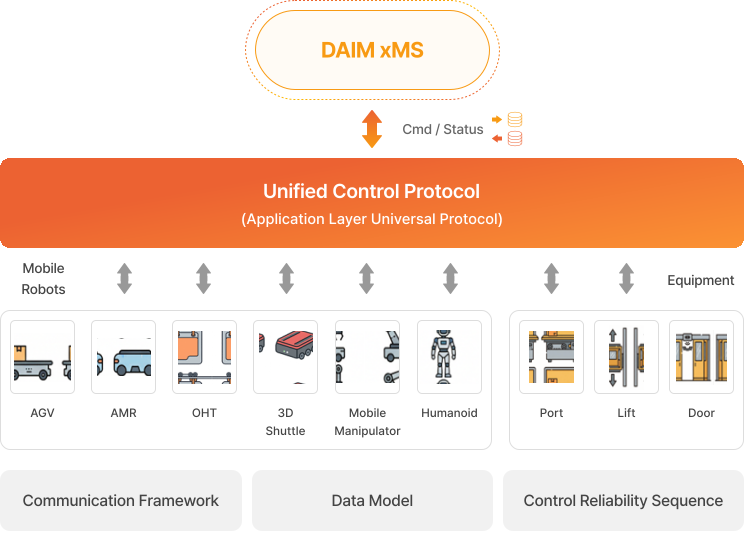
Built on DAIM's x-Control Protocol (xCP), Universal Fleet Management integrates multi-vendor mobile robots into a unified control platform. Regardless of robot manufacturer, it enables mixed-fleet operations at a single site while providing greater investment flexibility and system scalability.
-
- DAIM xCP-Based Integration Framework
- DAIM's xCP integrates robots and factory equipment through standardized control protocols—including VCP for mobile robots and LCP (Lift), DCP (Door), and PCP (Port) for factory equipment.
-
- Reliable Control and Continuous Operations
- A robust control architecture that maintains stable robot operations even during network disruptions, ensuring reliable system operation.
-
- Scalable Adapter Architecture
- Supports rapid integration of robots that do not natively support xCP through custom adapter development, enabling flexible system integration and future expansion.
Solution Core + Quick Integration
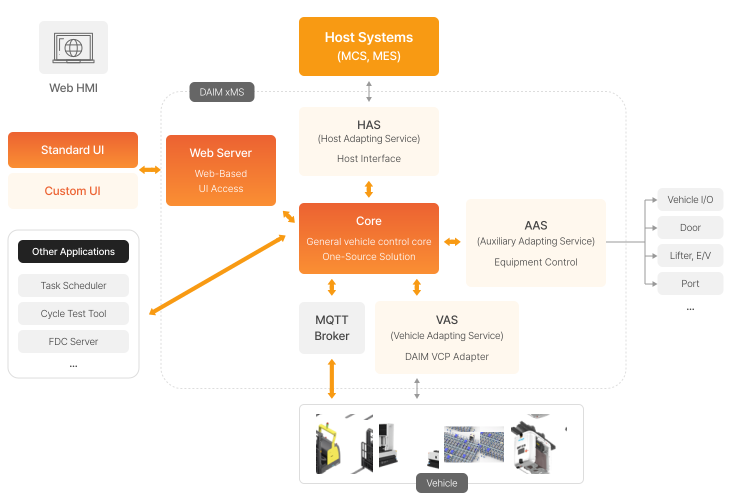
Built on a proven Solution Core with standardized capabilities validated across industries, and combined with a Custom Module architecture for rapid site-specific customization, this integrated architecture enables fast, flexible deployment of optimal control systems.
-
- Proven Solution Core for Stable Operations
- Leverages standardized capabilities proven across diverse industries to minimize initial deployment risks while providing a stable operational environment.
-
- Custom Module-Based Quick Integration
- Rapidly develops and deploys modular functions tailored to customer requirements, enabling site-specific system implementation.
-
- Scalable Adapter Architecture
- Separates the Solution Core from custom modules to minimize the impact of feature expansion and system modifications while supporting continuous enhancement.
FAQ
Key Questions to Ask Before Deployment
Yes. xMS enables unified operation of existing AGVs and AMRs through Universal Fleet Management. However, the existing AGVs/AMRs must support an open communication protocol for integration.
No. xMS is built on a vendor-independent architecture that supports mixed-fleet operations across multiple robot manufacturers, providing flexibility for future equipment replacement and system expansion.
Yes. Built on a unified multi-vendor robot control architecture, xMS makes it easy to expand robot fleets without modifying the existing system as additional robots are introduced.
xMS minimizes deployment risk through Digital Twin–based pre-validation and significantly shortens implementation time. Depending on the project scope, on-site system integration can typically be completed within 2 weeks to 1 month after equipment delivery.
Yes. xMS provides flexible integration with host systems such as MES, WMS, and ERP through standard APIs and interfaces, enabling integrated operations while preserving your existing IT environment.
Yes. In addition to integrating with host systems such as MES, xMS also supports lightweight robot call systems, including call stations and PLC-based triggers. System integration can be expanded incrementally as needed.
