

One-Stop Autonomous Manufacturing—
from Design to Deployment with DAIM Technology
From deploying multi-vendor hardware to optimizing operations,
DAIM sets the standard for autonomous manufacturing.
Successful End-to-End Implementation with a
Single Point of Accountability.
We select the robots and automation equipment best suited to your facility and integrate them into a unified system powered by DAIM's Physical AI. Using a vendor-neutral approach, we carefully select and recommend the logistics robots and automation equipment best suited to your production processes and material flow requirements.
Based on simulation-validated designs, we deliver successful end-to-end implementation—from equipment deployment through real-time integrated control—with a single point of accountability.
Offering
Why DAIM’s Service?
-
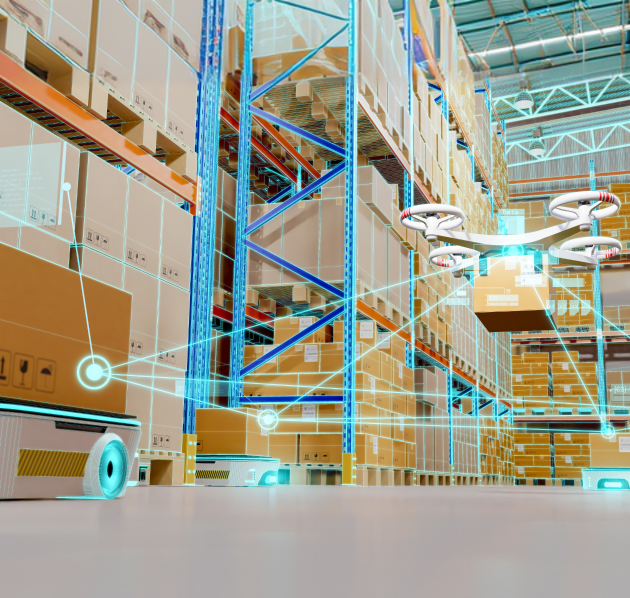
01 Vendor-Neutral Hardware Curation
Using a vendor-neutral approach, we select the robots and automation equipment best suited to your production processes and material flow requirements.
-
02 Unified Hardware Orchestration
Hardware from multiple vendors is unified through DAIM's Physical AI into a single system, enabling intelligent fleet orchestration.
-
03 Seamless Virtual-to-Real Deployment
Simulation-validated robot fleet sizing and material flow designs are implemented directly on the production floor, helping minimize trial and error during deployment.
Service Process
Turning Expert Analysis into Actionable Implementation
Vendor-neutral equipment curation combined with DAIM's proprietary Physical AI
enables simulation-validated designs to be deployed through unified control under a single point of accountability.
- Robots and automation equipment are selected based on material flow requirements and facility layout, independent of any specific manufacturer.
- Simulation-based analysis verifies that the selected equipment can achieve the required throughput before deployment.
- Project costs for the selected multi-vendor solution are estimated in advance to support investment decisions and maximize ROI.
- Robots and automation equipment from multiple vendors are orchestrated through Physical AI to operate as a single coordinated system.
- Complex interfaces between equipment, robots, and upper-level IT systems are standardized through DAIM's proprietary software, minimizing communication delays and errors.
- A real-time control engine dynamically reallocates robot tasks and optimizes robot movements in response to changing operating conditions.
- Robot fleet sizing and material flow designs validated through xSIM are accurately deployed to minimize trial and error during commissioning.
- Cycle times and production throughput are verified under real operating conditions before final deployment.
- DAIM serves as a single point of accountability from deployment through full operation, eliminating cross-vendor coordination issues and ensuring rapid post-deployment support.
Case Studies
Proven Results from Global Manufacturing Leaders
-
01 Challenge
- Uncertainty Around Existing Fleet Utilization : The customer had no objective way to verify whether its existing fleet of 50 AGVs was optimized for productivity and cost efficiency.
- Operational Inefficiencies and Bottlenecks : Aging AGVs and fixed operating logic resulted in recurring material flow bottlenecks and excessive waiting times.
- Deployment Risk : Although the customer was considering introducing AMRs, uncertainty in determining the optimal fleet size created the risk of unnecessary investment and operational disruption.
-
02 Solution
- Digital Twin Simulation Validation : A digital twin of the customer's facility was created to simulate multiple operational scenarios. Instead of simply expanding the fleet, simulation confirmed that the required material throughput could be achieved with only 30 AMRs.
- Vendor-Neutral AMR Selection and Supply : Simulation results were used to identify the AMR solution best suited to the customer's operations. The selected hardware was supplied through DAIM Technology's partner network.
- xMS Fleet Management Deployment : DAIM Technology's xMS (Fleet Management System) was implemented to enable real-time task allocation and dynamic route optimization. Together, simulation validation, hardware supply, and xMS Fleet Management delivered a complete end-to-end deployment.
-
03 Results
- 40% Reduction in Fleet Size and CAPEX : Simulation-based fleet optimization reduced the required fleet size by 40% (from 50 to 30), significantly lowering CAPEX while maintaining the required throughput.
- Higher Throughput with Fewer Robots : Although the fleet size was reduced, xMS's real-time optimization algorithms minimized material waiting times, maximizing both throughput and productivity.
- Complete End-to-End Implementation : Beyond supplying hardware, DAIM successfully established a complete end-to-end autonomous logistics model covering simulation validation, hardware deployment, and intelligent fleet management.
KAIST Physical AI Testbed
KAIST Physical AI Testbed: A World-Class Physical AI Integrated Operations Platform
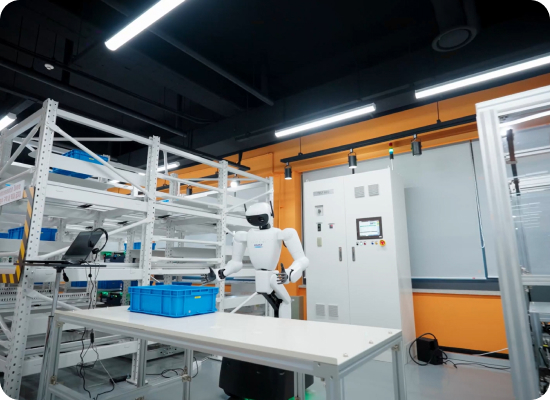
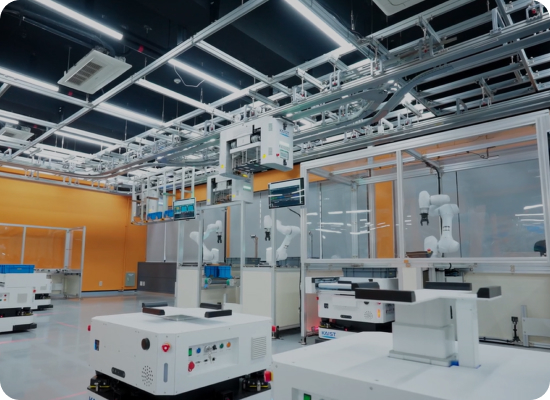
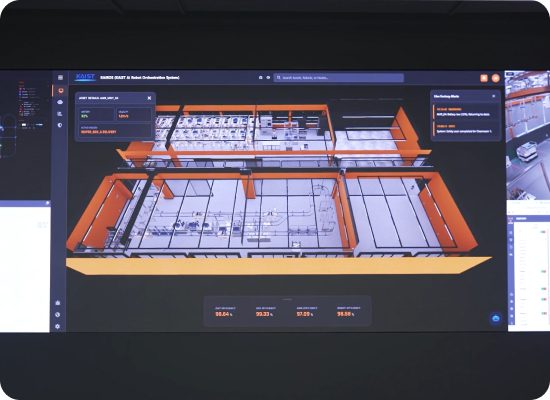
KAIST Physical AI Testbed is Korea's first Physical AI platform and autonomous manufacturing testbed, developed at KAIST under the leadership of DAIM Technology CEO Youngjae Jang and the company's co-founding team.
By synchronizing the digital twin with the physical factory, KAIST Physical AI Testbed enables logistics robots and production equipment from multiple vendors to operate autonomously without human intervention. Developed in collaboration with 13 Korean companies, KAIST Physical AI Testbed was built entirely with Korean-developed technology.
Watch Video
See autonomous manufacturing in action,
where different robots and complex production equipment operate as one coordinated system powered by Physical AI.
FAQ
Key Questions to Ask Before Deployment
Yes. DAIM Technology provides end-to-end implementation, covering everything from system design and hardware deployment to commissioning and full operation.
No. DAIM Technology is vendor-neutral and objectively recommends robots and automation equipment best suited to your production processes and material flow requirements.
Yes. DAIM Technology's Physical AI-based control technology integrates multi-vendor robots into a single coordinated system, preventing traffic congestion and enabling seamless collaboration.
DAIM's xSIM is based on digital twin technology that synchronizes virtual and physical environments on a 1:1 basis. Simulation-validated designs are deployed directly to the production floor, minimizing trial and error during implementation.
Yes. DAIM Technology integrates with your existing production equipment and IT systems—including MES and ERP—while optimizing system interfaces to enable seamless full-loop automation across the entire production process.
Yes. You can visit KAIST Physical AI Testbed to see robots and production equipment from multiple vendors operating together under unified control through DAIM Technology's Physical AI platform.
