
Insights
DAIM Insight
Explore the latest trends in manufacturing and logistics innovation through expert insights.
Opening
With thousands of robots on the factory floor, why is there a daily traffic jam at every intersection?
High-tech semiconductor, display, and secondary battery facilities have already achieved an exceptional level of automation. In a single 33,000-square-meter facility, roughly 1,000 OHT units handle over 500,000 material transfers a day.
Yet operating thousands of robots does not guarantee peak efficiency. When each robot simply takes the shortest route, specific bottlenecks inevitably form—eventually forcing human operators to step in. To make matters worse, integrating these systems remains difficult because different vendors rely on disparate languages and distinct control architectures.
A true Dark Factory cannot be built simply by adding more hardware. To succeed, factories need unified standards and a software framework that bridges these different robot languages while orchestrating throughput across the entire facility.
Key Highlights
Moving Beyond Fragmented Automation toward Facility-Wide Autonomy
-
Key Highlight 01
The key to resolving bottlenecks across thousands of robots: Intelligent avoidance algorithms and facility-wide orchestration, rather than individual shortest paths.
-
Key Highlight 02
Breaking vendor lock-in and lifting the integration burden for end-users: An AI-based unified standard protocol for mobile robots and automated equipment.
-
Key Highlight 03
Moving beyond standalone hardware competition: A Korean-style turnkey dark factory model exported as a fully integrated package.
Trend
DAIM Thoughts
Unifying Disparate Robot Languages: Building a New Standard for the Dark Factory

1. When Robots Insist on the Shortest Route, the Entire Factory Grinds to a Halt
[Source: Image generated by AI]
Advanced manufacturing lines have already automated much of their operations, running thousands of robots on site. Recently, facilities have begun exploring mobile manipulators and humanoid robots for remaining manual workflows, such as memory testing in semiconductor backend processes. In automotive and appliance components, mid-sized and small manufacturers are also increasingly inquiring about dark factory deployment due to shrinking labor pools and growing cost pressures.
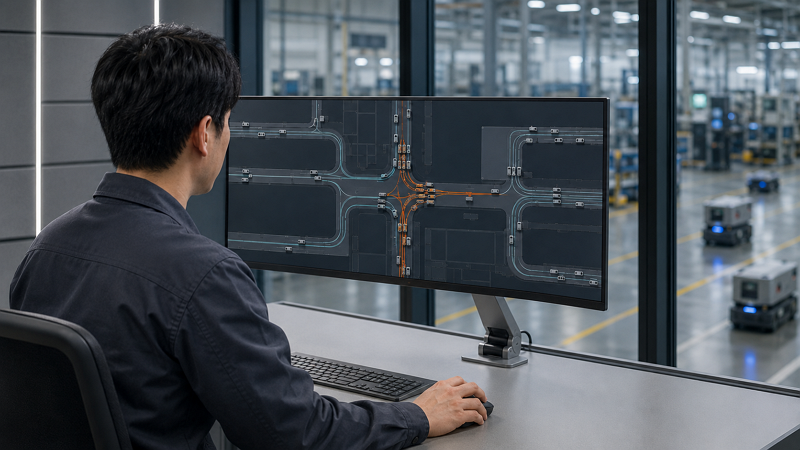
However, adding more robots does not automatically translate to higher productivity. In a 33,000-square-meter plant, if 1,000 robots all insist on taking their shortest individual paths, severe bottlenecks form along specific corridors. Resolving this challenge requires moving beyond isolated unit control: factories need intelligent algorithms and orchestration software that coordinate facility-wide material flow in real time, even amid variables such as shifting production plans or equipment breakdowns.
2. Unifying Disparate Robot Languages: Standardizing an Integrated Protocol
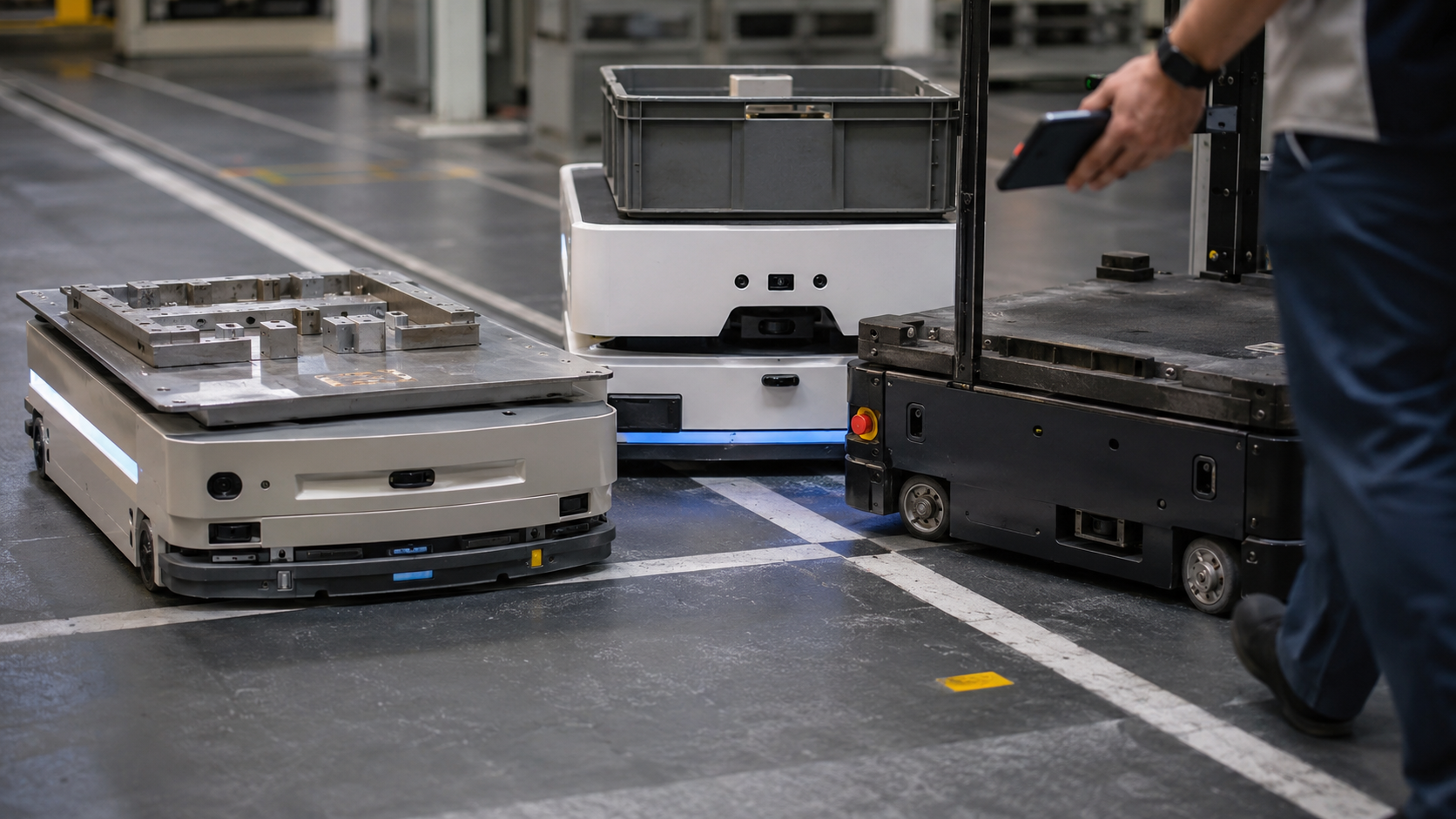
On actual production floors, heterogeneous robots from multiple vendors operate side by side—including automated forklift robots for receiving, compact AMRs and ACRs for sorting, and overhead OHTs. Yet because the industry lacks a common standard, the heavy burden of integrating and maintaining robots that speak different languages has fallen entirely on the end user. While standards like Germany`s automotive-driven VDA 5050 exist, they have clear limitations in covering general manufacturing sites and surrounding infrastructure such as automatic doors, elevators, and equipment ports.
To solve this, DAIM is spearheading the establishment of an "AI-Based Integrated Standard Protocol for Mobile Robots and Equipment," selected under the "National Standards Technology Enhancement Project" by the Korean Agency for Technology and Standards (KATS) under the Ministry of Trade, Industry and Energy (MOTIE), based on our proprietary interface specifications refined over the past six years in the field. Over the next two years, we are pursuing KS (Korean Industrial Standards) standardization, followed by a five-year initiative targeting international standards with ISO/IEC.
Once standards are clearly defined down to the application level, end users can flexibly select equipment without being locked into specific vendors, while capable robotics startups gain an ecosystem where they can validate and deploy their solutions on site without facing complex integration hurdles.
3. Moving Beyond Standalone Robot Competition: Toward Korea`s Turnkey Model for Full-Factory Exports
[Source: Image generated by AI]
With nearly two decades of manufacturing hollowing-out and high labor costs for unskilled workers, the U.S. faces a shortage of expertise in designing, building, and operating factories amid reshoring efforts. Meanwhile, China is engaged in a mass-production race backed by extensive robot component supply chains and foundation models.
Korea has no need to simply copy either the American or Chinese approach. The distinctive strength of Korean manufacturing lies in its deep, hands-on experience integrating complex, multi-layered systems on actual production floors.
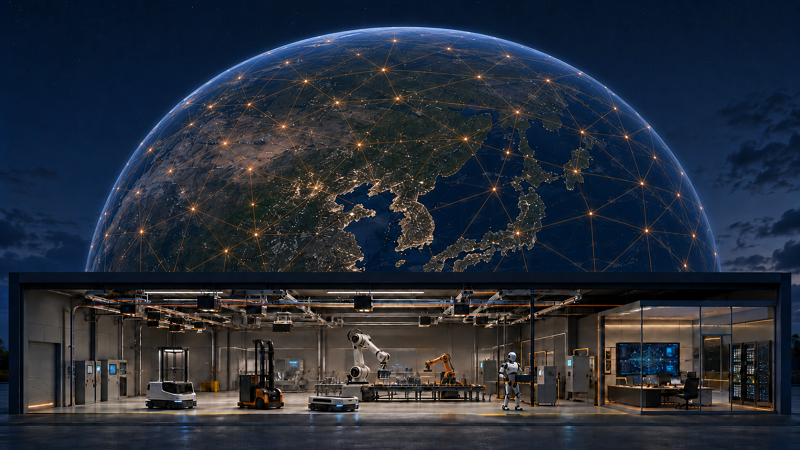
Just as German industrial consortiums once built turnkey plants abroad, bundling Korea`s sensors, actuators, robots, controllers, supervisory operational software, and digital twins into a single factory-level package can serve as a powerful new growth engine for exports.
Ultimately, a true dark factory is not where individual robots work in isolation, but where every robot and piece of equipment communicates through a unified language to maintain uninterrupted operational flow.
Moving beyond standalone automation to weave the entire facility into a single, cohesive organism through standardized protocols and orchestration software—this is the critical piece Korean manufacturing must focus on to lead the global market.
☞ This insight is summarized and adapted from the interview with DAIM CTO Ilhoe Hwang in the Korean Agency for Technology and Standards (KATS) Webzine Standard Issue Focus (Vol. 31).
[ Click here to read the original interview ]
2026.09.02DAIM Focus


