
Insights
DAIM Insight
Explore the latest trends in manufacturing and logistics innovation through expert insights.
Opening
The Real Future of Manufacturing: Powered by Physical AI
Hello, I am Young Jae Jang, CEO of DAIM Research.
The manufacturing industry is evolving faster than ever. With every emerging technology, many ask: "Can this truly transform our industry?" Having spent years in both research labs and dynamic shop floors, I have asked myself the exact same question countless times.
We launched DAIM’s newsletter, `D-Velop`, to explore these challenges and share practical answers.
Our goal is to demystify transformative technologies—such as AI, robotics, digital twins, and autonomous manufacturing—through an accessible, real-world lens. Rather than focusing solely on the tech itself, we spotlight the tangible impact and changes these innovations drive on the factory floor.
Our inaugural issue explores today’s most critical frontier: `Physical AI`
Key Highlights
3 Key Drivers Powering Next-Gen Manufacturing
-
Key Highlight 01
Physical AI Steps into Reality: Transitioning from Simple Automation to Autonomous Decision-Making
-
Key Highlight 02
The New Competitive Edge: Shifting Focus from `What to Make` to `How to Operate Flexibly`
-
Key Highlight 03
The Core of Autonomous Manufacturing: The Factory’s Brain via World Models and AI Orchestration
Trend
DAIM Thoughts
How Manufacturing is Evolving: The Future Powered by Physical AI
 1_49b0c.jpg)
AI is Stepping Beyond the Screen
Most AI we have encountered so far has operated strictly within the digital realm—drafting documents, answering questions, or generating images.
Today, AI is stepping directly into the physical world: across factories, logistics hubs, vehicles, and robotics.
_df0b0.png "eng%201.%20%ED%95%98%EB%82%98%EA%B8%88%EC%9C%B5%EC%97%B0%EA%B5%AC%EC%86%8C%20%27%ED%94%BC%EC%A7%80%EC%BB%ACAI,%20%EC%83%81%EC%83%81%EC%9D%80%20%ED%98%84%EC%8B%A4%EC%9D%B4%20%EB%90%9C%EB%8B%A4%20(2025)_df0b0.png")
[Source: Hana Institute of Finance, Physical AI: Turning Imagination into Reality (2025), AI-Generated Image]
An AI that perceives its environment, evaluates real-time conditions, determines optimal actions, and continuously learns from experience—this is Physical AI.
For manufacturing, this is far more than an upgrade in automation. It marks a paradigm shift: from factories that merely execute pre-programmed tasks to facilities that understand context and autonomously adapt their operations.
From Automation to Autonomy
Traditional automation requires humans to predefined every rule.
Engineers had to program how to handle every scenario and exception manually. Consequently, introducing new products or shifting production requirements demanded extensive reprogramming, leaving operations rigid and unable to respond dynamically to unexpected bottlenecks.
Physical AI takes a fundamentally different approach.
It synthesizes real-time data streams from sensors, vision systems, machinery, and robotics to understand current factory dynamics. It autonomously reconfigures production sequences, adjusts schedules, and continuously refines operational efficiency by learning from each outcome.
This marks the evolution from static automation executing human commands to true autonomy driven by self-governing intelligence.
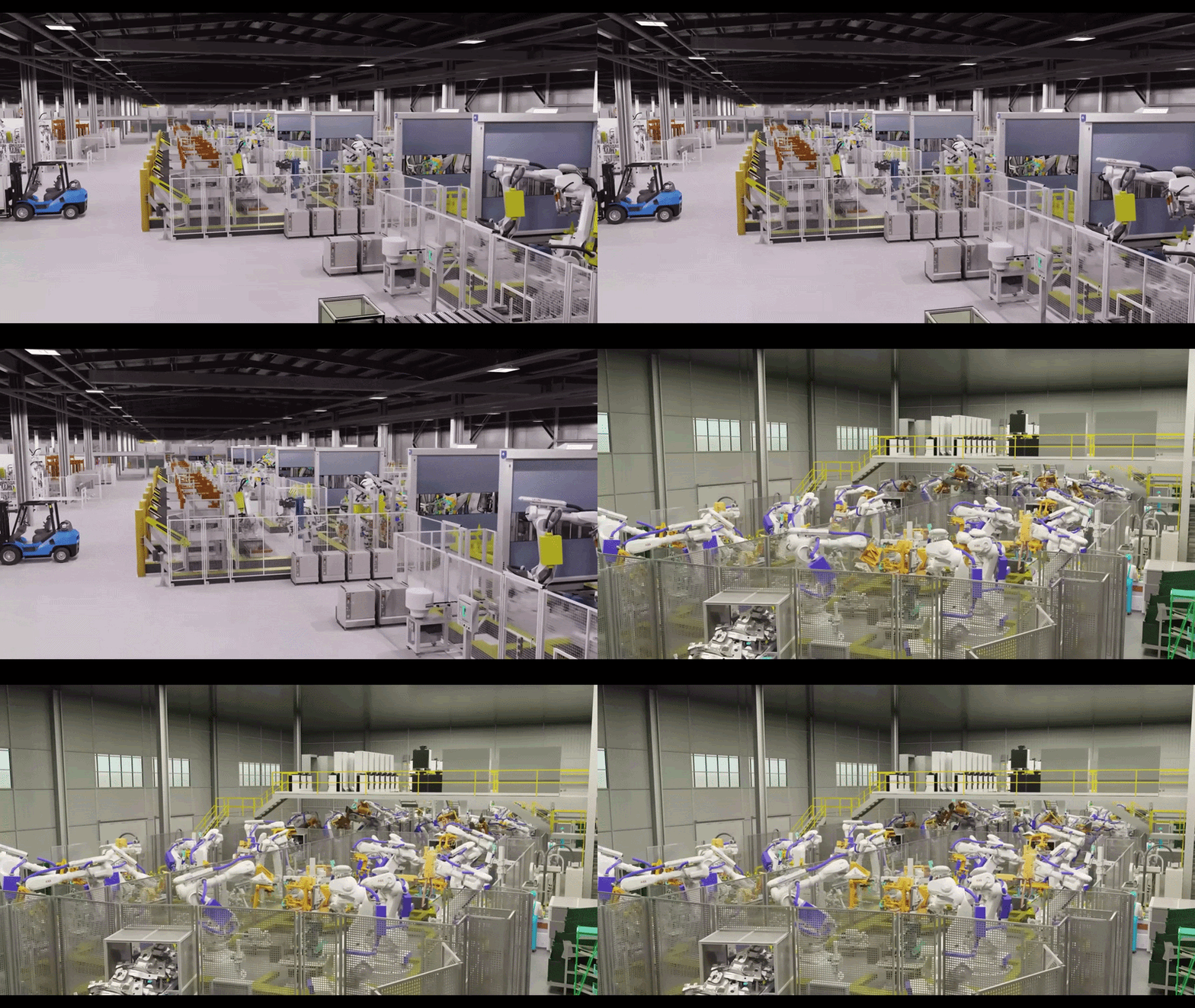
[Source: Official NVIDIA YouTube Channel]
Manufacturing Competitiveness is Defined by `Operations`
Moving forward, manufacturing leadership can no longer be defined solely by the ability to build high-quality products. Even with identical equipment, the true differentiator lies in who can operate facilities with greater stability, agility, and efficiency.
When sudden schedule changes or unexpected equipment faults occur, Physical AI recalculates production sequences and material handling routes across the entire facility to find the optimal path forward.
Manufacturing is shifting from `what you produce` to `how flexibly you operate.`
This operational intelligence—delivered via software and platforms—will become a scalable core competency across global plants.
The Core Enabler of Physical AI: World Models
Many wonder, "How does AI make these contextual decisions?" At the center of this capability is the `World Model.`
A World Model is an AI framework that learns the physical laws and dynamics of the real world to predict future outcomes. In short, it functions as the `factory`s brain`, understanding facility operations inside a digital environment and forecasting what comes next.
This technology serves two pivotal functions:
1. Pre-deployment Learning: Within a digital twin environment, simulation engines run countless virtual scenarios, allowing the AI to learn and optimize before going live on the shop floor.
2. Real-time Predictive Control: On the active shop floor, the AI continuously ingests real-time telemetry to assess conditions, anticipate potential bottlenecks or equipment failures, and proactively respond.

[Source: AI-Generated Image]
Ultimately, this synergy between AI and digital twin simulation provides the foundation for Physical AI to learn and evolve autonomously on the shop floor.
The Real Challenge Lies in Operations, Not Just Technology
While many enterprises initiate AI projects, few successfully scale them into daily operations. The primary bottleneck is rarely the AI algorithm itself; it is the lack of operational readiness on the shop floor.
Data architectures vary across facilities, workflows differ, and critical operational context often goes unrecorded. Without seamless integration into existing processes, even advanced AI initiatives often stall at the proof-of-concept stage.
Physical AI success requires more than standalone technology. Production, quality, logistics, and maintenance must unite within a unified operating framework—thoroughly validated via digital twins and continuously refined alongside frontline teams.
What We Need Now: Real-World Deployment
Some argue that falling behind in large language models means lagging in the broader AI race.
I see it differently.
South Korea possesses world-class manufacturing expertise across semiconductors, automotive, shipbuilding, batteries, and industrial robotics. Physical AI is precisely where these deep industrial strengths deliver maximum impact.
This technology cannot be perfected in isolation or on paper.
It evolves through rapid trial and error across real factories, actual robotics, and dynamic production lines. What we need now is less theoretical debate and more real-world validation. When enterprises, academia, and research institutions collaborate on the factory floor—accumulating insights from both successes and failures—Physical AI will truly become our next manufacturing frontier.
_1a952.jpg "KBS%20%EB%B0%A9%EC%86%A1%20(2026.03.30)_1a952.jpg")
[Source: KBS (Korean Broadcasting System) News, March 30, 2026]
In this inaugural issue, we explored the macro trends behind why Physical AI is becoming a pivotal transformation in manufacturing.
Physical AI cannot be realized simply by introducing a few advanced algorithms or robots. Real manufacturing environments require continuous orchestration among dozens or hundreds of disparate machines, mobile robots, and human operators. As automation levels rise, operational complexity increases, making it impossible to optimize the entire facility merely by controlling individual assets in silos.
In the era of Physical AI, true competitive advantage hinges on `AI Orchestration`—the ability to connect complex shop floors into a single, cohesive system, evaluate facility-wide dynamics, and drive optimal decision-making.
Starting with our next issue, we will dive deeper into `AI Orchestration`—the operating brain of future manufacturing—sharing real-world case studies on how leading facilities solve complex operational challenges. We look forward to continuing this journey, delivering practical, field-tested insights for the future of manufacturing.
Thank you for reading and staying connected.
2026.08.12
DAIM Focus


 1_0da47.jpg)
