
Insights
DAIM Insight
Explore the latest trends in manufacturing and logistics innovation through expert insights.
Opening
ChatGPT and manufacturing AI are fundamentally different… It is time to win with Physical AI!
When people think of AI today, ChatGPT or Large Language Models (LLMs) usually come to mind first. However, real factory floors can never be managed by language models alone. Even when replicating identical manufacturing processes, subtle environmental variables such as temperature, humidity, and operator skill levels produce vastly different outcomes. Unlike language domains where clear answers exist, complex manufacturing floors with countless variables offer no single correct answer.
Particularly with population decline and regional migration leaving local factories severely short-staffed and unable to operate, automation and uncrewed operations are no longer about job replacement—they have become an essential survival strategy. In this newsletter, we explore the true nature of Physical AI, which operates on a completely different dimension from generative AI, along with key strategies for Korean manufacturing to secure global leadership.
Key Highlights
ChatGPT is not Manufacturing AI… Time to bet on Physical AI!
-
Key Highlight 01
Shifting from isolated support to public data infrastructure
-
Key Highlight 02
Building a domestic unified factory OS and driving dark factory adoption
-
Key Highlight 03
Exporting turnkey factory packages under Team Korea
Trend
DAIM Thoughts
Building a sustainable manufacturing ecosystem with Physical AI and a unified factory OS
 1_85b8b.jpg)
In the global AI landscape, the United States possesses formidable IT capabilities but a weakened manufacturing base, while China boasts massive manufacturing infrastructure but faces limits in IT competitiveness. In contrast, Korea—equipped with world-class manufacturing infrastructure, process know-how, and a complete ecosystem spanning sensors, robotics, and communications—holds a unique and powerful position to take the lead in the new era of Physical AI.
However, to translate this opportunity into real industrial competitiveness, three fundamental mindset shifts are required to break through the limitations of legacy smart factories.
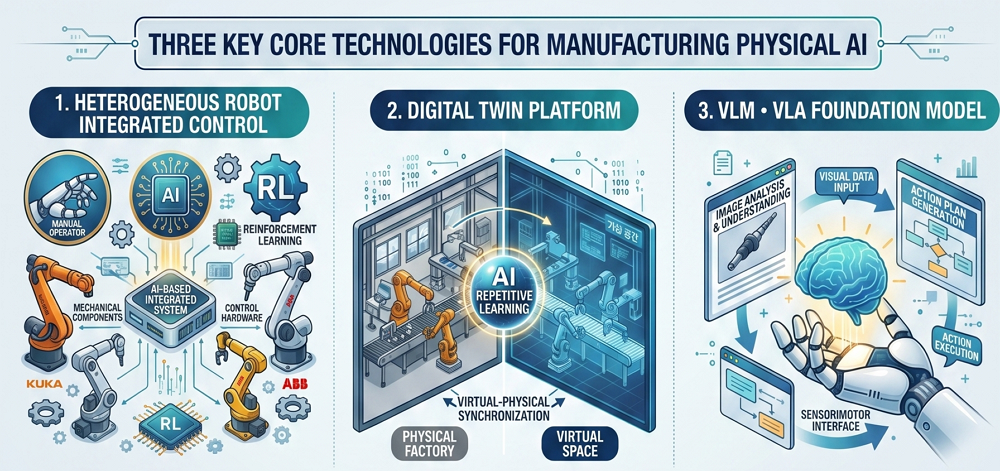
1. Unstructured manufacturing floors: Moving beyond LLMs to reinforcement learning and digital twins
[Image generated by AI | Source: KAIST Physical AI Research Center]
While language AI derives answers from public textual patterns, factories involve endless environmental variables, making it nearly impossible to reproduce identical results through simple data collection and training. Thus, the core of Physical AI lies in combining Reinforcement Learning (RL)—where systems self-optimize through trial and error—with digital twins.
Conducting repeated real-world factory experiments causes immense resource waste and costs; however, virtual environments allow thousands of simulations to run repeatedly without operational risk.
2. Breaking down $150k cost barriers: Domestic unified factory OS and uncrewed operations (Dark Factories)
[Source: DAIM Research, KAIST Physical AI Testbed Site]
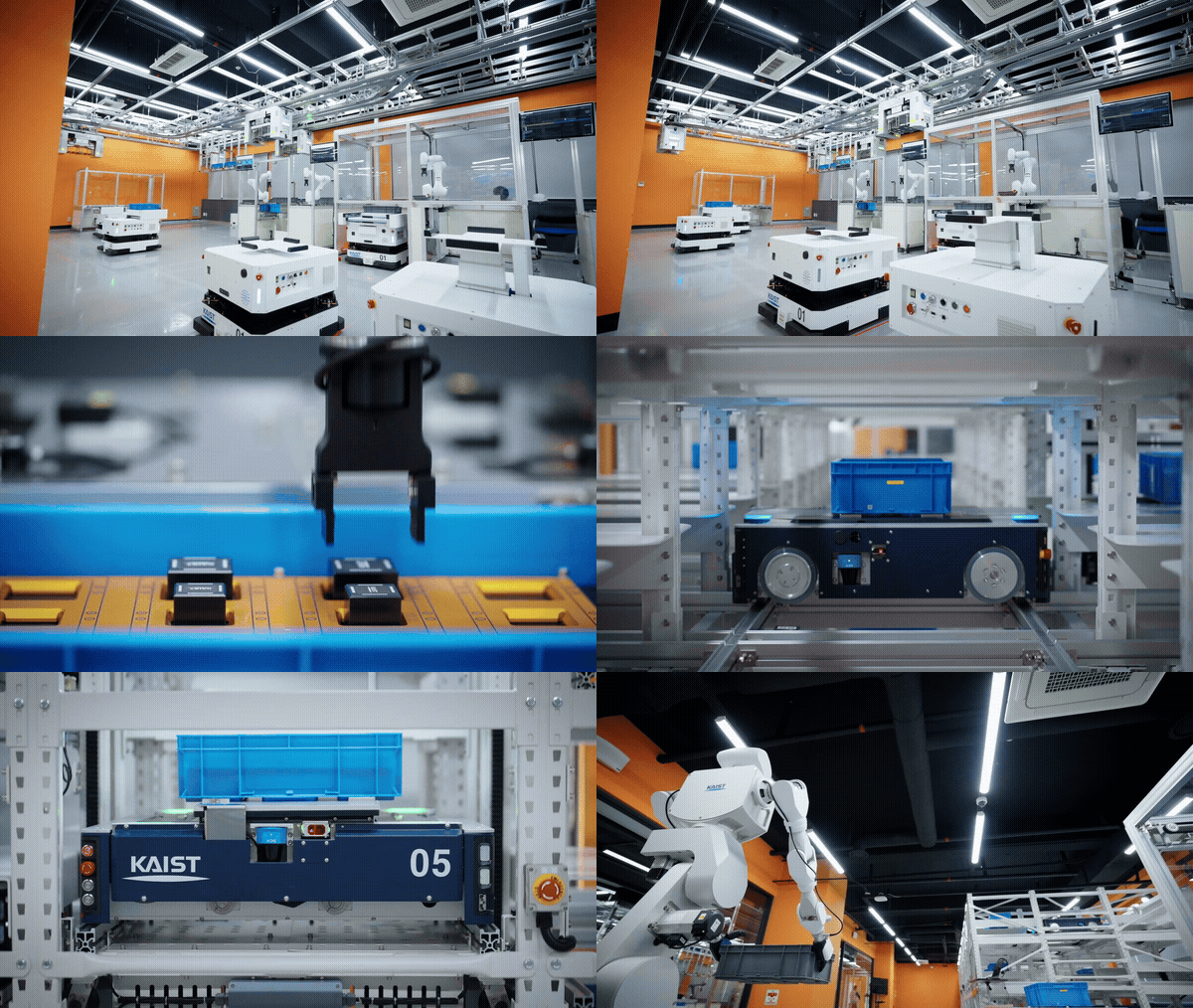
The biggest reason small and medium-sized regional factories hesitate to automate is high cost and complexity. Foreign factory design and operation software, such as Siemens, costs up to $150k in annual licensing fees alone—a prohibitive barrier for mid-sized manufacturers. Furthermore, adopting equipment and robotics piecemeal led to severe cross-system incompatibility.
What manufacturing needs now is a unified factory OS that allows AI to monitor facilities and logistics in real time and autonomously control operations without manual intervention.
Only when this standardized OS framework is established can entire factories transition into autonomously operating dark factories (uncrewed manufacturing).
3. Evolving from single-unit component sales to turnkey factory package exports
Domestic robotics and equipment providers cannot win individual survival battles against US or Chinese competitors by selling standalone hardware. Just as designing and building a turnkey structure yields far higher value than selling raw materials, the same principle applies to manufacturing AI.
This is proven by the field results at the Jeonbuk Testbed and KAIST Testbed, where applying Physical AI to actual automotive component manufacturing significantly boosted productivity and quality. We must finalize a Team Korea strategy that bundles domestic manufacturing OS, robotic hardware, and IT infrastructure into complete turnkey factory packages for global export.
Ultimately, robotics adoption and uncrewed operations are not about replacing workers, but providing a vital lifeline to regional manufacturing suffering from labor shortages. Factories are massive, long-term markets requiring continuous maintenance and expansion rather than one-off builds.
A Korean-style Physical AI factory package unifying hardware and software represents a sustainable survival strategy for domestic manufacturing—and our most powerful export asset to reshape global markets.
[Recommended Lecture] Factory & Logistics Automation Systems Using Physical AI (CEO Chang Young-jae)
https://www.youtube.com/watch?v=4icd1YqPxSM
2026.08.10
DAIM Focus


