
Insights
DAIM Insight
Explore the latest trends in manufacturing and logistics innovation through expert insights.
Opening
Beyond Robots: Why Manufacturing Needs a Factory OS
While the US and China race over the flashy mechanical performance of humanoid robots, real manufacturing shop floors must ask a more fundamental question: Does making a single robot smarter truly raise the productivity of the entire factory? Deploying robots without prior traffic and workflow analysis creates intersection bottlenecks and severe congestion, ultimately forcing human operators to step back in. Edison’s true greatness lay not merely in inventing the light bulb, but in building the generation, transmission, and distribution power systems that transformed global living.
What manufacturing needs today is not isolated equipment automation, but an integrated manufacturing operating system (OS) that connects and autonomously controls the entire factory as a single, organic system. In this edition, we share key manufacturing OS strategies alongside recent Physical AI-based uncrewed factory testbeds to help Korean manufacturing secure leadership in the global market.
Key Highlights
Moving past AX rejected by the field—where should we start changing?
-
Key Highlight 01
A Physical AI framework optimizing factory-wide logistics and operations
-
Key Highlight 02
A cloud-based approach lowering technical barriers and cutting design time
-
Key Highlight 03
A factory OS powered by domestic AI semiconductors
Trend
DAIM Thoughts
Building a Korean-style manufacturing OS to control the entire factory as one giant robot
 1_a2c2b.jpg)
1. Moving from isolated equipment automation to factory-wide intelligence
Traditional automation required engineers to hardcode rigid, single-lane traffic rules for every site. However, in complex environments where heterogeneous machinery—such as Autonomous Mobile Robots (AMRs), Overhead Hoist Transports (OHTs), and 3D shuttles—operates simultaneously, responding to real-time variables is nearly impossible.
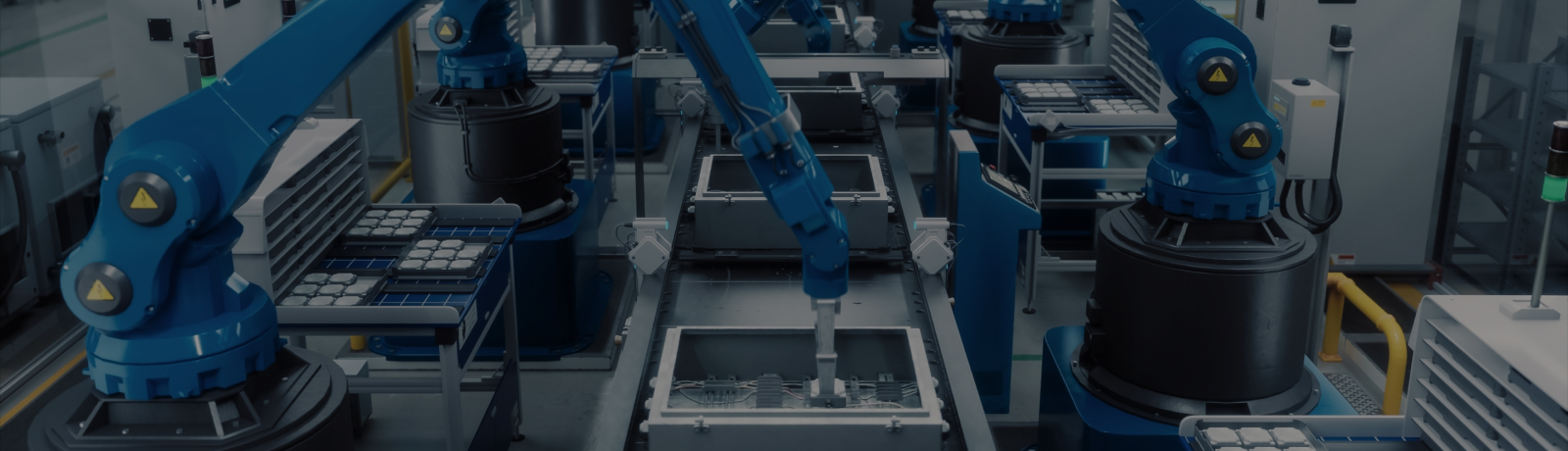
An autonomous manufacturing platform views the entire factory as one massive robot; AI detects narrow bottleneck points or intersection traffic in real time, recalculates paths, and dynamically reassigns tasks. Even if a reroute appears longer for an individual robot, making decisions that serve global optimization prevents factory-wide throughput bottlenecks—the true essence of Physical AI. This pursuit of total optimization is precisely why DAIM has relentlessly researched heterogeneous multi-robot fleet management (xMS) without compromise.
2. Overcoming the $150,000 cost barrier with operational data and digital twins
The primary reason small and medium-sized enterprises hesitate to automate is the steep cost of foreign simulation software—reaching up to $150,000 annually—and a lack of specialized personnel.
Overcoming this requires pre-validating task feasibility and bottlenecks within a virtual factory (digital twin) to minimize the Sim-to-Real gap between virtual models and physical operations. By delivering cloud-based Physical AI technologies that automate complex robot layout and path planning in hours rather than weeks, we must establish a standardized operational data ecosystem where production, logistics, and facilities connect contextually on the floor.
3. Building a full-stack OS with domestic NPUs and remote factory infrastructure

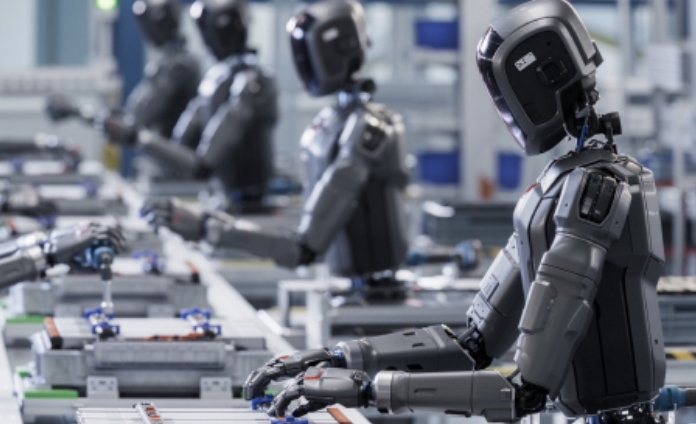
[Source: Image generated by AI]
While foreign solutions depend heavily on GPU-intensive, heavy simulation environments, a field-ready manufacturing OS should aim for a lightweight, agile platform combining domestic Neural Processing Units (NPUs) with edge sensor and communication hardware.
Furthermore, we must establish a remote factory operating infrastructure capable of managing overseas plants directly from headquarters. Leveraging Korea`s world-class operational expertise across semiconductor, automotive, and battery plants to remotely manage overseas facilities allows us to safeguard core domestic technological IP and jobs while exporting complete, turnkey factory operating systems globally.
Ultimately, the battleground of global manufacturing lies not in single-piece robot capabilities, but in an integrated manufacturing OS that autonomously operates the entire factory. It is time to secure sustainable competitiveness for Korean manufacturing through field-validated operational data and intelligent control platforms.
DAIM Focus

 썸네일 업무협약_08161.jpg)
 JB미래포럼조찬세미나_436eb.jpg)
 DAIM logo_2ab24.png)
 다큐인사이트_4ce7c.jpg)
 기업간담회_11764.jpg)
