
Insights
DAIM Insight
Explore the latest trends in manufacturing and logistics innovation through expert insights.
Opening
Is AI reserved only for big conglomerates? The real battleground lies on the shop floors of micro-manufacturers with under 10 employees.
In discussions across the manufacturing sector today, AI Transformation (AX) is undeniably the top topic. Yet taking a closer look, the focus remains almost entirely on flashy autonomous manufacturing implementations by large corporations. Micro-manufacturers, the very foundation of the industrial ecosystem, feel left behind.
Making up 88% of all manufacturing entities in Korea, facilities with nine or fewer employees face aging equipment, labor shortages, and high costs that make even basic digitization feel overwhelming, let alone AI adoption. Furthermore, businesses that invest heavily in automated machinery often face disconnected systems that fail to communicate, driving up labor costs to resolve integration friction.
In this edition, we share three core execution strategies designed to break through these barriers and drive meaningful productivity transformation across small and micro-manufacturing shop floors.

Key Highlights
Stop ignoring AX in the field—where do we start?
-
Key Highlight 01
Shifting from isolated support to public data infrastructure
-
Key Highlight 02
Adopting site-specific appropriate technology over overly complex AI
-
Key Highlight 03
Implementing unified OS-based standardization and pre-validation frameworks
Trend
DAIM Thoughts
Building a strong manufacturing powerhouse starts with an AI ecosystem tailored for micro-manufacturers
 1_daaed.jpg)
While the digital transformation of manufacturing is advancing rapidly around corporate-led autonomous production, achieving sustainable industrial competitiveness requires the active participation of micro-manufacturers, who represent 88% of the entire industry. However, in practice, shortages of skilled personnel and high capital requirements present significant barriers to adopting new technology.

[Source: Ministry of SMEs and Startups, 2024 Smart Manufacturing Innovation Survey (Reprocessed by Korea Small Business Institute, Dec 2025)]
A Snapshot of AI Adoption in Domestic SME Manufacturing
- SME AI technology adoption rate: 0.1% (with only 1.6% planning adoption)
- Smart factory maturity: 75.5% remain at the basic level (less than 0.3% at advanced levels)
- Adoption rate of AI and Digital Twins: under 0.5%
Compounding the problem are piecemeal support efforts—tantamount to throwing a few extra logs into a traditional wood-burning kitchen—and visionless, fragmented tool purchases. When Manufacturing Execution Systems (MES), inventory tools, and Automated Guided Vehicles (AGVs) are sourced from different vendors without integration planning, incompatibility costs months of troubleshooting and hundreds of thousands of dollars in lost labor. To solve this, smart manufacturing strategies for micro-manufacturers must pivot across three major fronts:
1. Transitioning from isolated support to an equipment and public platform model
Just as restaurants join shared delivery platforms rather than building custom apps from scratch, micro-manufacturers do not need to construct proprietary, standalone systems. Instead, they require platforms capable of extracting data directly from shop floor machinery and storing it in a standardized format. Expanding this into a public infrastructure model involving government bodies and industry associations prevents private monopoly while building a dependable data ecosystem for small-scale industry.
2. Combining essential shop floor appropriate technology with conversational AI
Micro-manufacturers do not require overengineered AI frameworks.
Accessing basic operational signals—such as whether a machine is running or exhibiting anomalous behavior—delivers immediate value. Installing lightweight data collection modules on key machinery and pairing them with a MachineGPT trained on equipment manuals enables operators to ask natural questions like, "The machine stopped—what is the root cause?" and receive instant diagnostic answers based on real-time sensor data and documentation.
3. Unifying systems under a single OS and establishing pre-simulation validation
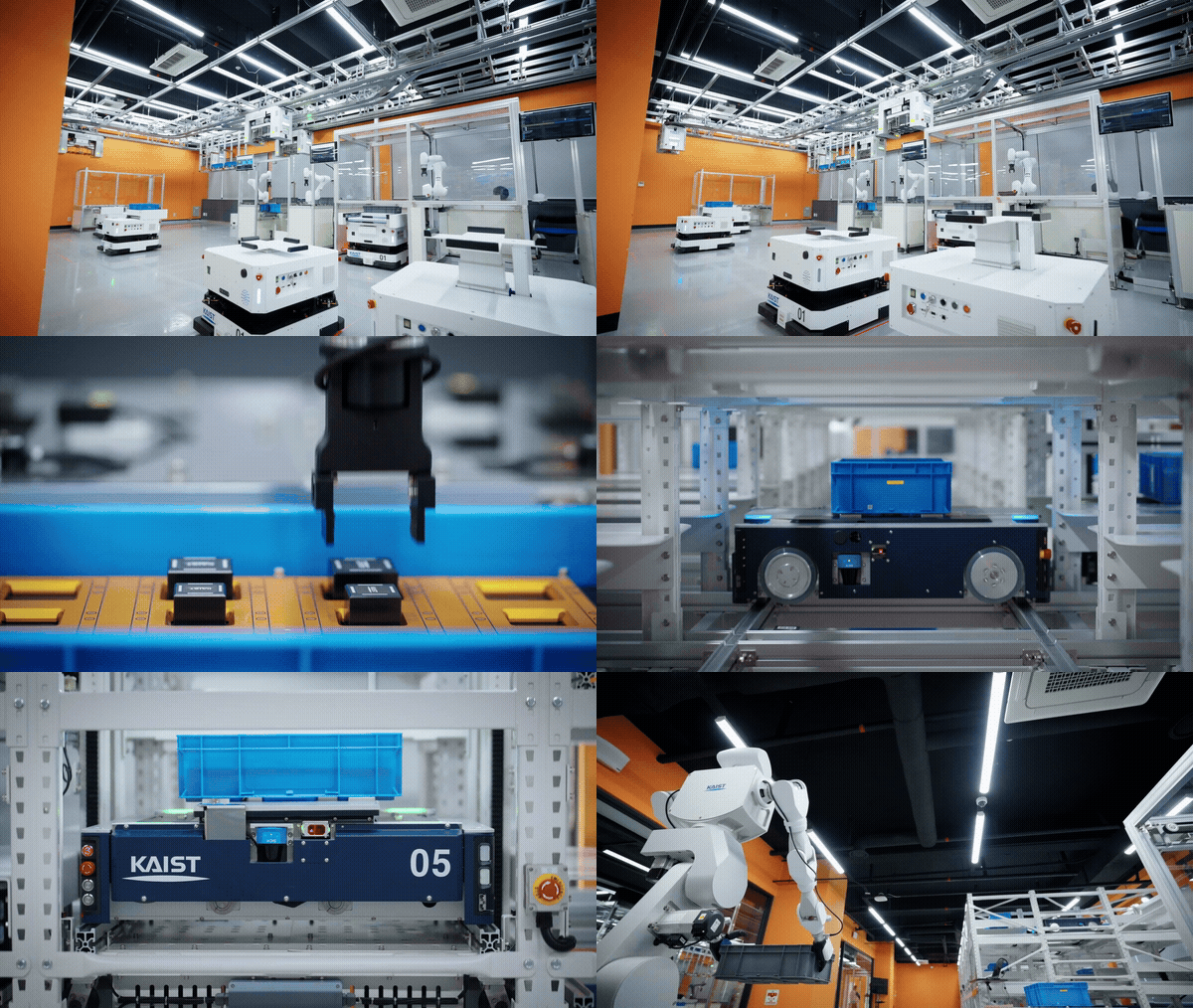
[Overview of the KAIST Physical AI Autonomous Factory Testbed controlled under a single OS]
Fundamentally resolving the issue of fragmented smart factories requires unified standards and rigorous pre-validation, operating the entire factory under a single Operating System (OS) rather than controlling isolated machinery.
Before making heavy capital investments in robotics or complex machinery, providing micro-enterprises with a risk-free 3D virtual environment to simulate workflows, layout efficiency, and required unit counts dramatically reduces the risk of project failure.
Furthermore, as demonstrated by the Physical AI Autonomous Factory Testbed built at KAIST under a Ministry of Science and ICT initiative, deploying an agent-based single operating system (xMS) to control facilities and execute real-time supervisory decisions delivers concrete field performance: reducing per-unit manufacturing time by 30 minutes and boosting overall productivity by 7.4%.
Ultimately, successful AI transformation is not achieved by installing a few high-tech robots or disconnected software packages.
True change begins when field data accumulates systematically and a standardized operating framework connects siloed equipment. The goal is an inclusive manufacturing ecosystem where small and micro-manufacturers grow strong alongside major corporations.
Field-ready appropriate technology combined with unified standards that remove hardware silos serve as the definitive foundation for the entire manufacturing industry to take its next leap forward.
DAIM Focus


